

This support notes are suitable for:
- ABSS Accounting
- ABSS Premier
|
Introduction At the end of every fiscal year, a trustee will make distributions to the Trust's Beneficiaries. MYOB accounting software is very useful in handling the business affairs of a Trust and the distributions to beneficiaries. This support note provides two methods for dealing with Trust related transactions. |
How can I deal with beneficiary distributions at the end of the fiscal year?
Detailed below are two methods of dealing with beneficiary distributions at the end of the fiscal year, both providing the same end result. Both methods should be read before making judgment on which method to use.
Method 1
Step 1 - Modify your Accounts List
The Accounts List will need to be adjusted slightly to reflect the distributions made to the beneficiaries. Set up liability accounts (2-0000) for distributions made to the beneficiaries, but not yet paid. Each beneficiary should have a liability account.
Set up other expense accounts (9-0000) called distribution to beneficiaries. Once again, each beneficiary should have a distribution account.
Step 2 - Distribute income to the beneficiaries
Make a general journal entry on the last day of the fiscal year (or in the 13th period if using 13 periods) to distribute income to the beneficiaries.
Debit the Other Expense (9-0000) accounts and credit the corresponding Liability (2-0000) accounts for the amount of profit distributed to each beneficiary.
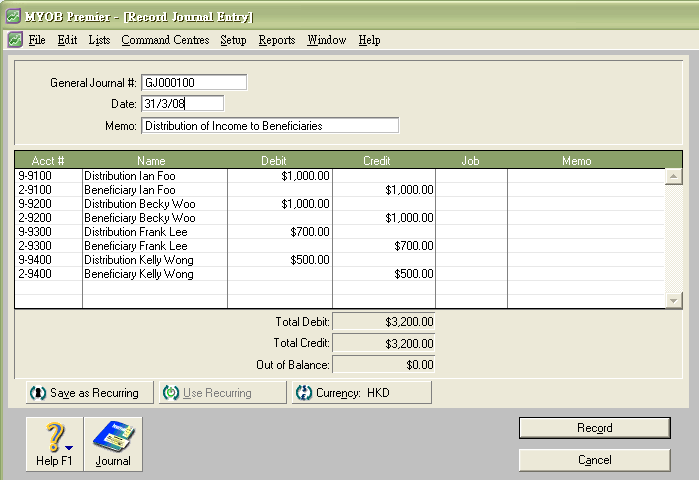
Note: Assuming that all profits made by the Trust are distributed to beneficiaries, the bottom-line figure on the Profit and Loss statement will be $0. Current year earnings in the Balance Sheet will also have a zero balance. Any profits made by the trust for the year are now in the beneficiary liability accounts.
Method 2
Step 1 - Modify your Accounts List
The Accounts List ( in earlier versions called Chart of Accounts) will need to be adjusted slightly to reflect the distributions made to the beneficiaries. Set up liability accounts (2-0000) for distributions made to the beneficiaries, but not yet paid. Each beneficiary should have a liability account.
Step 2 - Distribute income to the beneficiaries
Make a general journal entry on the last day of the fiscal year, the first day of the new fiscal year, or in the 13th period if using 13 periods to distribute income to the beneficiaries.
Debit the Retained Earnings equity (3-0000) account and Credit the beneficiaries- Liability (2-0000) accounts.
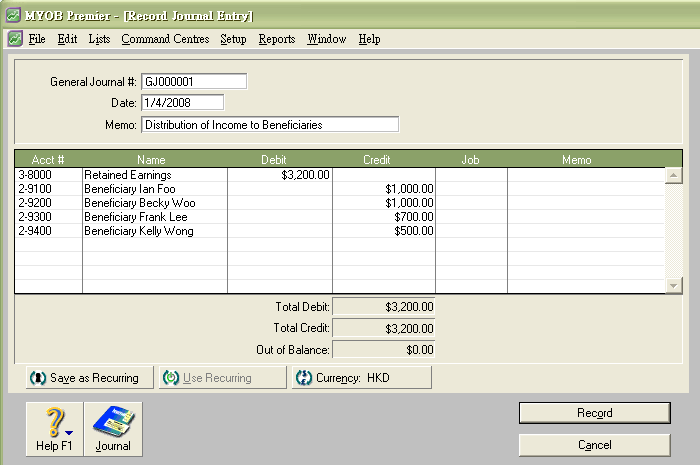
Note: Method 2 will have no effect on the profit amount appearing in the Profit and Loss statement.
- If the entry is made on the 30* June (or in the 13th period) and all profits earned by the Trust have been paid to the beneficiaries, as at the 30“ June the Retained Earnings account will have a negative balance. The Current Year Earnings account will have a corresponding positive balance. Once Start A New Year has been performed, both Current Year Earnings and Retained Earnings will be zero as at the 1“ July.
- If the entry is made on the 1“ July, Retained Earnings will be $0, and Current Year Earnings will contain the balance as at 30“ June. Once Start A New Year has been performed, and assuming all profits earned are paid to beneficiaries, both Current Year Earnings and Retained Earnings will have zero balances as at 1“ July.
When beneficiaries are eventually paid their entitlements, select Spend Money in the Banking command centre and allocate the amounts paid to the individual beneficiaries‘ liability accounts.
Comments
0 comments
Please sign in to leave a comment.